Friday, 15 June 2012

The Last Post

Today we learned about electrical power, and got some formulas:

P=VI,   P = V^2 / R,   and P = I^2 / R

The SI unit for Power is Watts.

We also learned about power rating, and how to read an electric meter.

We also got steps to find electrical cost:

  • Find power and convert to kW
  • find hours
  • multiply time by power
  • multiply by rate.
Electrical sefety

We learned:
  • all voltages are dangerous
  • AC is more dangerous than DC
  • Electrical shock is a jarring shaking sensations that can cause burns.

Thursday, 14 June 2012

Ohm's Law

    In Tuesday's class we reviewed electrical resistance. This determines how much current is drawn from an electrical energy source when an appliance is "plugged in."
   Resistance depends on the conductor within it. Resistance of a conductor depends on these four things:

  • Length- the more length, the more resistance
  • Thickness- thick wire provides less resistance
  • Temperature- Higher temperatures lead to higher resistance. Super-conductors have a resistance of near zero when in extremely low temperatures.
  • Nature of the Material- different substances provide different resistances.
After this brief review, we went on to learn Ohm's Law

Ohm's Law states that V=IR

  • If the voltage is constant, an increase in current (I) must be the result of a decrease of resistance.
  • If the resistance is constant, an increase in voltage results in a directly proportional increase in current.
     Current generally depends on the voltage and the resistance. However, note that Ohm's Law only works for Ohmic materials. (We won't work be working with any Non-Ohmic materials.)

The total resistance for resistors in series is equal to the sum of each individual resistor.

RS = R1 + R2 + R3 + R4 + __ + Rn

The total resistance for resistors in parallel is a reciprocal relationship.

1  =  1  + 1   + ...... + 1 
RP      R1    R2                   Rn

As more resistors are added, the total resistance will become less, thus increasing the voltage.


1.) If a battery maintains a potential difference of 65 Volts across a circuit and a current of 5.0 A flows through it, what is the resistance?

V = 65                       V = IR
 I = 5.0                      R = V  = 65  = 13 Ohm's of resistance
R = ?                                 I     5.0


We concluded the class by going over several examples.


Wednesday's Class

We spent all of Wednesday's class working on practice problems from the text book.
The assignment was:
  • Pg. 649 # 1-6
  • Pg. 653 # 1-2
  • Pg. 655 # 1-2
  • Pg. 659 # 1-5
  • Pg. 673 # 21 a-e

Brady will post next

Tuesday, 12 June 2012

Kirchoff and Resistance

In Monday's class  we started by watching Krystle's Prezi presentation and then reviewing what was learned on Friday.
We then started to learn Kirchoff's Current Law which states that:
  1. The current is conserved in a series circuit  I1=I2=I3=IT
    2. The total current in a parallel circuit is the sum of the current through each resistor connected in parallel.  I1+I2+I3=IT
    We also learned Kirchoff's Voltage Law which states:
    1. In a series circuit the total voltage is the sum of the potential difference across each individual resistor   V1+V2+V3=VT
    2. In a parallel circuit the voltage is conserved and the potential drop across each resistor in parallel is equal to the total voltage. V1=V2=V3=VT  
    In this class we also started to learn about Electrical Resistance which affects the amount of current drawn from and electrical energy source.
          The resistance of an appliance depends on the conductor within it and the resistance of the conductor depends on these four things:
  1. Length- more length=more resitance
  2. Thickness- a thicker wire has less resistance than a skinnier wire
  3. Temperature-hot=more resistance cool=less resitance
  4. Nature of the Material- different substances provide different resistances
         Finally we learned the formula to calculate resistance

          R=p(L/A)                   R= Resistance
                                                      p= Resistivity
                                                      L=Length
                                                     A=Area

Next is Brittany

Sunday, 10 June 2012

Electric Circuits

We started Friday's class by watching the remaining Prezi presentations, and reading about outlets. Following the reading, we started a section on electric circuits.
Electricity Terminology:

  • Electromotive Force (e.m.f) - the potential difference at a power source when no current is being drawn. The e.m.f of a regular "plug-in" is 110V. 
  • Battery- a group of two or more cells. One cell is like a "AAA battery."
  • Series Combination- when cells are connected with the positive terminal connected to the negative terminal. The electromotive force ( or voltage) is the sum of each cells. 
  • Parallel Combination- all the negative terminals are joined together and so are the positive. 
Electric Circuits:

  • A circuit always has an energy source (battery), an electrical appliance (bulb), a controlling device ( switch), and a protective device (fuse). The fuse is typically not included in the diagram. 
  • Series Circuit- The electrons only have one path to travel. The circuit diagram above is a series circuit. 
  • Parallel Circuit- there is two or more paths that the electricity can take. 


We finished the class by looking at Kirchoff's Circuit Analysis.
Kirchoff's Current Law 
  • 1. The current is conserved in a series circuit. It is the same throughout the circuit. 


Shelby is next! 

Monday, 4 June 2012

Electric Current and Electric Potential Energy

  • In Fridays class we learned of electric fields and how to calculate the intensity of it using the formula:
E=F/Q; where E=electric field intensity (N/C); F=electrostatic force (N); Q=charge(C)

  • To finish off the class we compared electric current to the flow of water through a hose.  The two types of current are:
-Alternating Current (AC) which is current that periodically changes direction
-Direct Current (DC) where all the current is in one direction


  • In Mondays class we learned the concept of electric potential energy.
  • To summarize we can say that opposite charges attract and similar charges repel.
We then moved onto electric potential difference which is more commonly known as voltage.  It is the amount of energy needed to move a charged particle from one point to another.  We can calculate voltage with the formula:

                                                         V=W/Q
Where; V=potential difference (volts)
            W=work(J)
            Q=charge(C)

  • To finish off Monday's class we learned of electrical grounding.  The point of a grounding wire is to carry excess charge away from the appliances and people and into the ground which has a charge of zero.


Next is Indianna


Wednesday, 30 May 2012

Electric Field

In todays class we learned about an electric field.


An electric field is a region in space where a force is exerted on a positive test charge.  It is a region that would cause a test charge to move if it were placed within the region.

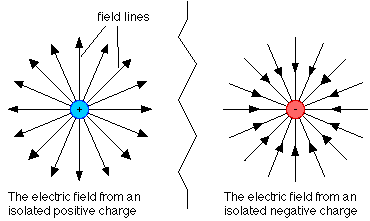
Electric Lines of Force- lines that represent the direction that a freely moving positive test charge will move in an electric field.  These lines originate at positively charged objects and terminate at negatively charged objects.


The strength of on electric field is shown by the distance between field lines.  The filed is stronger when the lines are closer together.


The field lines want to be as far part as possible from each other.  When the charge is negative the field lines will point towards it and positive they will point away format he charge.


1st ~ B < A
2nd~ C < D
3rd~ G < E < F
4th~ J < H < I
We determine this by the number of field lines coming off or going to the charges.


Next is Kurtis


Tuesday, 29 May 2012

Electricity and Coulomb's Law

Today in class we talked about how Coulomb's are the SI unit of a charge.

1 C= 6.24 x10^18 Electrons   1 Electron= 1.60 x10^-19

So the charge of one electron is called the Elementary charge. This charge is also the charge of 1 proton.

To find the charge on an object we use the formula  Q = Ne 
                                                                              Q= the quantity of charge
                                                                              N= number of elementary charge
                                                                              e=  the elementary charge (always 1.60 x10 ^-19

Ex.    Calculate the charge on a metal-leaf electroscope that has an excess of 5.0 x10^10 electrons.

Q= ?                                                                   Q= Ne
N= 5.0 x10^10                                                   Q= 5.0 x10^10 (1.60 x10^-9)
e= 1.60 x10^-9                                                   Q= -8.0 x10^-9C


Coulomb's Law


This is the formula which is applied to find the magnitude of the force of repulsion or attraction between two charges.
                                                                          F=K q1q2
                                                                                   d^2


F= electrostatic force
q= charge (C)
d= distance (m)
k= 8.99 x10^9Nm^2/C^2 (always)

A negative force implies an attractive force.
A positive force implies a repelling force.

krystle is next

Monday, 28 May 2012

Into Electricity!!!


In today's class we were introduced to the unit of Electricity. We used textbooks to match terms with their definitions. From this, we established:


Elementary Charge- the magnitude of the charge on a single proton or electron.

 e=1.602x10⁻¹⁹C, where C= 1 coulomb


Electric Circuit- A closed-loop conducting path, consisting of a source of electrical energy, a conductor, and a load, which utilizes the electrical energy.


Conductor- known to have an electrical charge because it has excess or a deficiency of electrons. The charge is distributed over the surface of the conductor because of the similar charges’ repulsion.


Electric Current- the rate of which charges flow at- passing through a cross-sectional area in a conductor. It is considered to be a flow of positive charges.


Ammeter- used to measure the electric current in an electric circuit, and is connected in a series with the circuit.


Schematic Diagram- a plan or design which represents the components and their relationship to one another by symbols


Direct Current- the continuous flow of electrons in the same direction


Alternating Current- periodic reversal in the direction of the flow of electrons


Fundamental Law of Electrical Charges:

-opposite electric charges attract each other

-similar electric charges repel each other

-charged objects attract neutral objects


Conduction- is the process in which a neutral object gains a charge through contact with a charged object


Induction- an electrically charged object being used to create an electric charge on another object without touching.


After learning about these concepts, Mr. Banow proceeded to show demonstrations of  Electrostatics. He did so by showing the transferring of charges between a balloon, wall, and sweater. We ended the class with Mr. Banow experimenting with a Van de Graff Generator.


Next is Ryan J


Tuesday, 22 May 2012

Gravitational Potential Energy and Total Energy

In Wednesday's class, we did not really do anything but answer the questions from page 290 #1-4 for the whole class.

In Thursday's class, we started the class by reading the pages 291-292 in our textbook about Potential Energy and Law of Conservation of Energy. After that, we then proceed and read through our notes about Gravitational Potential Energy and Total Energy.

Gravitational Potential Energy (Eg) is the energy that is stored when an object is placed in a vertical  position relative to the ground level (which is the surface of the earth or the floor of any room), or any base level.

The formula you can use to find the Eg of an object is:

Eg = mgh

where:
Eg = Gravitational Potential Energy (Joules or J)
m = the mass of an object (kg)
g = acceleration due to gravity (9.8 m/s^2)
h = change in height relative to the reference point (m)

*** There are other types of potential energy but in this class, when potential energy is mentioned, only gravitational potential energy is usually used.

Ex. A hydraulic hoist lifts a 1100 kg car 2.5 m. What is Eg?
m = 1100 kg 
h = 2.5 m
g = 9.8 m/s^2
Eg = ?

Eg = mgh
Eg = (1100kg)(9.8m/s^2)(2.5m)
Eg = 27000 J

After talking about gravitational potential energy, we also talked about Total Energy. 

In an object, there will be an equivalent increase in gravitational potential when work is being done. When an object is raised, potential and kinetic energy interchanged which means when one of the energy would increase, the other one would decrease. The sum of kinetic and gravitational potential energy remains constant in any system, and the total value of energy remain constant (Law of Conservation of Energy).

Etotal = Epotential + Ekinetic

Note **** Friction and Air Resistance are ignored in Conservation of Energy.

Examples:

1. Roller Coasters
- There would be most potential energy or gravitational energy at the highest point of a roller coaster (and there is zero kinetic energy) 
- At the lowest point, kinetic energy is when it has its maximum value (or zero potential energy)

2. Pendulums
- The distance from equilibrium is like the height above earth.

3. Springs
- There are more Elastic Potential Energy a spring has when it is further deformed. 
- The formula you can use to find elastic potential is: 
Ep(elastic) = 1/2kx^2
k = the spring constant (every spring has a specific k value)
x = how far from the equilibrium the spring is depressed or stretched (also called Hooke's Law)

Ex. A compressed spring that obeys Hooke's Law as a potential energy of 18 J. If the spring constant of the spring is 400 N/m, find the distance by which the spring is compressed. 
Ep = 18 J
k = 400 N/m
x = ?

Ep = 1/2kx^2
(2Ep)/k = x^2
(2(18J)) / 400 = x^2
36/400 = x^2
x = 0.30m

Wednesday, 16 May 2012

Kinetic Energy( It Moves!)

In yesterdays class we learned more about energy and its different forms. We learned that
  • Kinetic Energy (Ek) is the energy of motion
  • Potential Energy (Ep) it the energy of rest
  • Change in energy = Final Kinetic Energy - Initial Kinetic Energy (if on a level surface)
  • Work = change in kinetic energy
  • Ek = 1/2mv^2
  • kinetic energy is a scalar quantitiy
  • its SI unit is Joules(J)
ex. 1 If an 8.0 kg mass moves at 35m/s what is its kinetic energy?

Ek = 1/2(8.0kg)(35m/s)^2  Ek = 4900J

We also learned more about collisions.
  • An Elastic Collision is when there is no loss of energy.(rarely happens)
  • An Inelastic Collision is when there is some energy lost 
  • An Completely Inelastic Collision is when two objects stick together  

Tuesday, 15 May 2012

Physics Works

We began the class of May 14th by reviewing the concept of Work(W). The key ideas of this concept are:
  • Work is the product of an applied force and the displacement of an object in the direction of the applied force.
  • Work is a scalar quantity
  • The SI unit of Work is Joules (J)
  • If there is no applied force, there will be no work done
  • If there is no displacement there will be no work done
We then proceeded to do some example problems.

ex.

A boy pulling a wagon is exerting a force of 20.0 N at an angle of 35 deg to the horizontal. If he pulls it 100.0 m along the ground, calculate the work done.


Cos35 =   Fax                                                                          W = Fd
              20.0N                                                                        W = (16.38 N[fwd]) (100.0m[fwd])
Fax = 16.38 N [fwd]                                                                W = 1600J


   We also learned that work can be calculated from an applied force vs displacement graph by finding the area underneath the graph. However, estimation is sometimes needed when a graph is curved.

  We continued with the day's lesson by learning about Energy (E)
  • Energy is the ability to do work
  • When work is done, energy is transferred from one object to another
  • Unit is Joules
  • An increase of Energy of an object means that the work done on it will be positive and vice versa
  • Not all Energy is used when it is converted from one form to another
  • Energy efficiant products minimize lost Energy
***Time does not change the amount of work done, it does however tie into POWER***

What is Power (P)?
  • The rate at which work is done
  • The rate at which energy is used
  • SI unit is the watt (W)
  • Power = work
  •                time
  • The more time it takes to complete a task, the less power is had.

Ex:
A man does 120 J of work in lifting a box from the floor to the table. If it took 2.0 s to perform the task what is his power?

W = 120 J                                         P = W                       P = 120 J              P = 60. W
 T = 2.0 s                                                  T                               2.0s
 P = ?

And thus concludes the class that took place on Monday May 14th, 2012
type=text <-- work done!

Sunday, 13 May 2012

YAY work

Good day everyone. On Friday we started a new chapter in physics, all to do with work, power and energy. We started by listing what we knew about the topic and came up with several pieces of information including:
  • It takes energy to do work
  • You get energy from food 
  • Electricity is a form of power (Steam power, coal power)
We also discussed kinetic and potential energy, kinetic energy being the amount of energy an object has while it is in motion and potential energy being the amount of stored energy and object has.

Example of Potential Energy:

Holding a football above the ground, has potential energy due to the force of gravity because if you let go, the ball will fall to the ground. The higher you hold the ball the more potential energy the football has.

Work:

After discussing the informtion we already knew about the subject we finally defined Work as the product of an applied force and the displacement of an object in the direction of the applied force. In other words it is when we apply a force to an object and the object moves in the direction the force was applied or in the opposite direction.

W=Fd 

W= work F=force d=displacement

Unit = Joules (J)


If there is no applied force upon an object or there is a displacement of zero, no work has been done. For example if you pushed all day on a wall but the wall has not moved, you have made no progress therefore you have done no work.


FarSide.jpg

Also no work has been done if the force being applied and the displacement of the object are perpendicular to one another. For example a satellite orbiting the earth, the satellite is moving forward around the earth but gravity is pulling the satellite down, by definition it is not work.

Positive work- when the applied force and the displacement act in the same direction
Negative work- when the applied force and the displacement act in opposite directions

We followed all of this great knowledge with some examples.

1. Find the work required to lift a 3.0x10^3 kg object to a height of 5.0 m?

F=mg                                                   W=Fd
F= (3.0x10^3 kg)(9.8 N/kg)                W=29400 N x 5.0 m
F= 29400 N                                         W=15000 J
d= 5.0 m
W= ?

2. A person pushes a loaded box 55.0 m by exerting a horizontal force of 35.0 N on the box. How much work is done?

d= 55.0 m                                            W=Fd
F= 35.0 N                                            W= 35.0 N x 55.0 m
W= ?                                                    W= 1925 J = 1930 J (significant digits)

(If the object is not being lifted we do not have to worry about mass x gravity as in example 1.)


father-lifting-child.jpg


Wednesday, 9 May 2012

Conservation of Momentum!

In Thursday's class we learnt about the laws of conservation of momentum. We learnt that initial momentum is equal to final momentum. An isolated system is one where no external net force acts on the system. There are four types of explosions and collisions.

1. Explosion from rest: M1V1 = -M2V2
2. Explosion from motion: (M1+M2)Vi = M1Vf1+M2Vf2
3. Elastic Collision: M1V1i+M2V2i = M1V1f+M2V2f
4. Inelastic Collision: M1V1i+M2V2i = (M1+M2)Vf

Example: A 0.205 kg hockey puck moving at 51 m/s is caught by a 80.0 kg goalie at rest. With what speed does the goalie slide on the ice?

M1V1i+M2V2i = (M1+M2)Vf
Vf = M1V1i / M1+M2
Vf = (0.205kg)(51m/s) / (80.0kg+0.205kg)
Vf = 0.13m/s


Next up is Susanne

Wednesday, 2 May 2012

Impulse And Momentum!

Yesterday we already had our Labs set up and went straight to work. We began our Impulse and Momentum labs. The objective were to 1. Measure a cart's momentum change and compare to the impulse it receives. 2. Comapre average and peek forces in impulses. We began the lab by using the web quest and a cart connected to an elastic band  finding final velocity, and  initial velocity on the lab quest. From here we could determine change of velocity. We then took the average force which helped us to find durations of impulse and the impulse.  From the lab we took down the data and were able to compare and constrast Impulse and change of momentum. We found out that  mpulse equals the change in momentum.

Next up is Ty.

FREE FALL AND MOMENTUM!

On Friday's class we finished up learning about free fall and terminal velocity. We then started learning about momentum. Momentum can be described as "inertia in motion". The more mass and velocity an object has, the more momentum. This can be found through the formula p=mv.

ex. What is the momentum of a 1 kg piece of fecal matter being flung by a monkey at 15 m/s [E]?
    m= 1kg                              p=mv
    v= 15 m/s [E]                    p= (1 kg)(15 m/s[E])
    p= ?                                   p= 15 kgxm/s [E]

On monday's class we started setting up for impulse and momentum lab. We answered some general question about momentum and how if an object is in contact with a force for a longer period of time, it will have more momentum.

Next up is Dylann. Sorry my blog post sucks.

Monday, 30 April 2012

Terminal Velocity and Free Fall!

On Friday's class we did our fun Friday quiz, and then proceeded to learn about free fall and terminal velocity.

Everything is subjected to the force of gravity, which is the force that pulls down objects during free fall!
During free fall, objects experience a force that slows them down known as air friction.
Free falling objects in air reach a state where they no longer can accelerate, or increase speed, from the force of gravity and the force of air resistance equalling each other. This is known as terminal velocity! As something is falling, for example a baseball falling from a pop fly, air resistane against the ball has a direction upwards and becomes so great that it equals the force of gravity pulling the baseball down. Once the two forces equal each other, the baseball cannot fall any faster. Mass, shape, size, and surface texture are all different factors that can change the value of terminal velocity for certain objects.


We discussed an example of a sky diver. They are free falling until they hit terminal velocity, and to slow them down they pull to let their parachute out. The air resistance then acts on the parachute, allowing them to slow down.

Thursday, 26 April 2012

Continuation with Force and Friction!

For the last few days we have been doing experiments to learn about force and friction.
From these experiments we have learned:

·         Increasing the mass of the cart increases the friction and force.

·         The rougher the surface the greater the friction and force.

·         When an object is pulled up a slant there is a greater amount of force due to gravity pulling the object down.

·         When an object is pulled down a slant there is less force and friction because gravity is pulling the object down the slant.

·         Force acts through the centre of the object. Meaning that no matter what the surface area is there will be the same amount of friction.  

After talking as a class about our results with the experiments we did an example with force.

A 4.0 kg block of wood is sliding on a horizontal table top. What force must be applied to the mass to give it an acceleration of 0.50m/s2? The coefficient of kinetic friction is 0.30.


m= 4.0kg                Fnet=ma                                                    Fn=mg
a= 0.50m/s2                              =(4.0kg)(0.50m/s2)                              = (4.0kg)(9.8m/s2)
μk= 0.30                        = 2.0N                                                    = 39.2N
Fa=?
Fnet=?                                                                  Ff= μFn                                                                 
Ff=?                                                                                                    = (0.30)(39.2N)                            
Fn=?                                                                        =11.76N 

                                               Fnet= Fa + Ff
                           2.0N[forward]= Fa + (-11.76 [forward])
                                           Fa= 2.0N[forward] + 11.76N [forward]
                                             Fa= 14N [forward]

After the example we did questions from the text book on page 169, #1-4. Lastly, Mr. Banow also mentioned about a Friday quiz.

Kenzie is next!

Tuesday, 24 April 2012

Finding the Force of Friction

In today's class we went over yesterday's blog post and then proceeded to come up with various experiments that we could do to measure the limiting static friction of a cart. Limiting static friction is the maximum value of the force of friction which occurs just before the object begins to move. We came up with various different experiments to find the limiting static friction:
- Using different masses on the cart.
- Testing the cart on different surfaces.
- Pulling the cart up an incline.
- Pulling the wooden block down an incline.
We also tested the frictional force of two separate sides of a box to determine whether surface area affects the force of friction. In addition, we were to determine the coefficient of static friction for the green cart and the black cart and compare the two values. The values of limiting static friction were very low for the cart, increasing as weight or angle increased, and also increasing on rougher surfaces.

The sled would have low limiting static friction due to the smooth texture of the sled and it's light weight.
Casey is next!

Monday, 23 April 2012

Friction Forces Unite!

Today (A.K.A. yesterday) we started off class by checking over Friday's quiz, and we reviewed the lesson from Friday.

We reviewed the formula:  FF = Fn*µ , that tells us that the force of friction is equal to the normal force (represented by the object's weight) multiplied by the friction coefficient.

We also reviewed that the coefficient for static friction is greater than the coefficient for kinetic friction.

We then took some notes, and learned that friction only exists when a force is being applied We also learned that forces act through the center of the object, so friction has nothing to do with the surface area.

Mr. Banow then did a demo where he attached a force sensor to a wooden object, to show us the idea of limiting static friction. The force peaked just before the object moved, then leveled out as it moved.

The last thing we did was some examples of the Friction Force Formula, fortunately forementioned for frequent and fervorous figuring of Friction Forces (holy alliteration, Batman!). One of these examples was the following question:

The total weight of Physics Boy (on skis) is 500N. If it takes 35N for Calculus Man to start Physics Boy moving (so he can help somebody find the slope of a tangent on a specific point), determine the coefficient of static friction.

The formula is: FF = Fn*µ

  • We are trying to find µ.
  • FF is 35N, because this is the Limiting Static Friction 
  • Fn is 500N, because the normal force is the same as the object's weight.
So we substitute and solve:
                           
35N = 500N*µ
35N/500N = µ
µ = 0.07
The friction coefficient between Physics Boy's skis and the snow is 0.07
There are no units, because  Newtons/Newtons = 1, so they cancel.

Nicole, you're next!

Sunday, 22 April 2012

Friday Quiz + Friction

On Friday's class Mr. Banow did some quick review with the class before handing out our quiz on GRAVITATIONAL FORCES.... After we had finished that the class proceeded with notes on friction.

We learned that there are many different types of friction such as:

Static Friction- The friction that tends to prevent a stationary object from moving

Limiting Static Friction- The maximum value of the force of friction before the stationary object moves

Kinetic Friction- the force of friction that opposes the motion.


We also wrote down the Force of  Friction Formula


Fn= Normal force
Ff= Force of friction
μ= Coefficient of friction


Next up will be Brady if he shows up.